
St. John Parish Arrest History
The St. John the Baptist Parish Sheriff’s Office is the primary parish patrol, investigative, warrant, and jail agency. Its official Arrests Reports archive publishes dated posts with the recorded name, age, locality or address as released, and charge or warrant description. Reports frequently distinguish judicial, bench, attachment, and fugitive warrants and mark many allegations as felony or misdemeanor. Juvenile entries are anonymized.
Each report warns that publication under the Public Records Act does not imply guilt or wrongdoing. The archive is a recent publication channel, not a full name-based criminal history. A later charge can differ because the District Attorney decides what to file. A final outcome belongs in the St. John criminal court case maintained by the Clerk.
Inside the St. John Arrest Archive
Browse the official Sheriff arrest-report archive by a likely arrest date. Record the spelling, age, locality, charge text, and warrant type exactly. A sample official report confirms the archive’s layout and cautionary language.
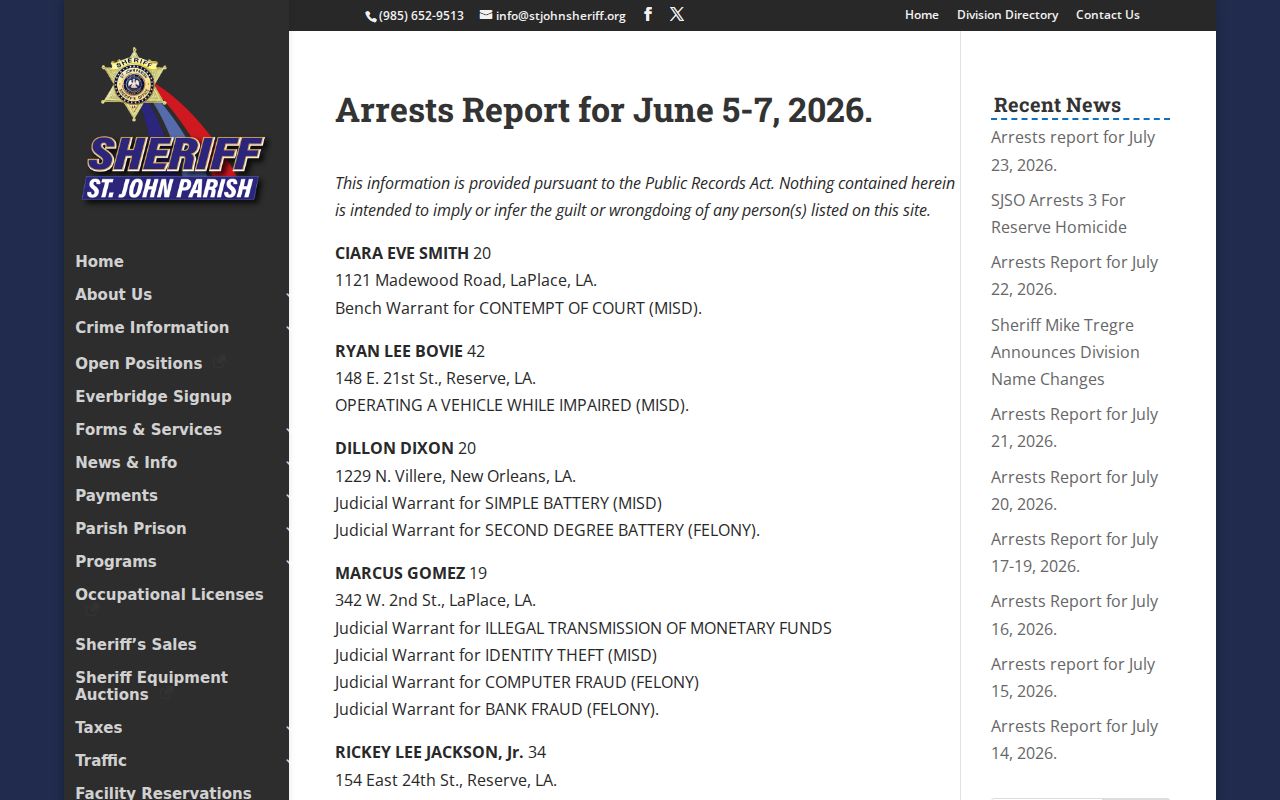
A locality line such as LaPlace, Reserve, or Garyville is not proof that the incident happened there, and it does not establish residence or guilt. A dated post may also remain after release or dismissal. Use it as a lead to the jail, agency report, and court docket.
Looking Up St. John Parish Arrests
No single channel supplies every stage. Begin with the arresting agency, then follow custody and prosecution. If Louisiana State Police, Wildlife and Fisheries, Probation and Parole, or a federal agency made the arrest, that agency may hold the incident report even when the person was booked locally.
- Browse the Sheriff’s dated Arrests Reports for the relevant period.
- Check the parish roster or VINELink, or call 985-359-8625 for current custody.
- After filing time, search Clerk Connect for a 40th JDC docket.
- Request the narrative from the arresting agency with the incident date and item number.
- For your own fingerprint-linked statewide history, order an LSP Right to Review through LAPS.
- Confirm the outcome with a certified disposition from the Clerk.
An absence from VINE can mean release, transfer, delayed indexing, or no jail booking. It does not erase the arrest. After transfer to a Louisiana prison, use the Louisiana DPS&C Imprisoned Person Locator; federal imprisonment belongs in the BOP locator.
From St. John Report to Booking
At the St. John Parish Correctional Center, staff verify identity, inventory property, photograph and fingerprint the person, enter the charges delivered at intake, screen immediate medical and safety needs, classify custody, and route the matter for judicial and bond processing. The facility is at 100 Deputy Barton Granier Drive in LaPlace, and prison information is available at 985-359-8625.
A booking charge is provisional. Release may follow bond, recognizance, dismissal, sentence completion, transfer, or court order. Call the facility before attempting to post bond and confirm the exact amount, bond type, payee, accepted instrument, and release location. Operational vendors and visitation rules can change.
Identity data and fingerprints from a custodial arrest can move through Louisiana’s criminal-justice network to the LSP Bureau of Criminal Identification and Information. That repository cycle is separate from the jail roster and the later court file. Timing can differ across all three systems. A recent Sheriff post may appear before a docket exists, and a court disposition may take time to reach the state history. For a careful review of one’s own record, compare the agency report, the 40th JDC disposition, and the fingerprint-based Right to Review rather than treating one screen as complete.
Inside a St. John Arrest Record
An arrest-side file can contain more detail than the short public post, but active and protected parts may be withheld. The agency that created the report is the proper custodian.
| Event identity | Report or item number, incident date, time, and location. |
|---|---|
| Person data | Identity and descriptors, with protected identifiers redacted. |
| Arrest facts | Arrest date, arresting agency or officer, and legal authority. |
| Allegation | Charge and statute, plus warrant type or number when public. |
| Booking | Destination, booking identifier, fingerprints, photograph, and property receipt. |
| Status | Bond or custody information when entered, plus public supplements. |
Requesting a St. John Arrest Narrative
A one-line post rarely contains the probable-cause narrative. Use the Sheriff’s public-records page, call 985-652-9513, visit headquarters at 1801 West Airline Highway in LaPlace, or mail a focused request. Supply the case or item number when known, incident date, location, people involved, record type, and contact details.
St. John Sheriff Headquarters
1801 West Airline Highway
LaPlace, LA 70068
985-652-9513
Mail: P.O. Box 1600, LaPlace, LA 70069.
The published fee form lists $50 for a CD, $25 for printed documents up to five pages, $1 per page when six or more pages are supplied, and $10 for mailing. Fees are due before processing. Checks or money orders are payable to the Sheriff’s Office and mailed to the post-office box, attention Deputy Lindy Torres. The form does not promise card, cash, email, fax, or drop-box payment.
St. John Sheriff Request Channel
The official Sheriff public-record page is the source for the current request route. Its captured page helps a reader distinguish the government channel from commercial people-search sites.
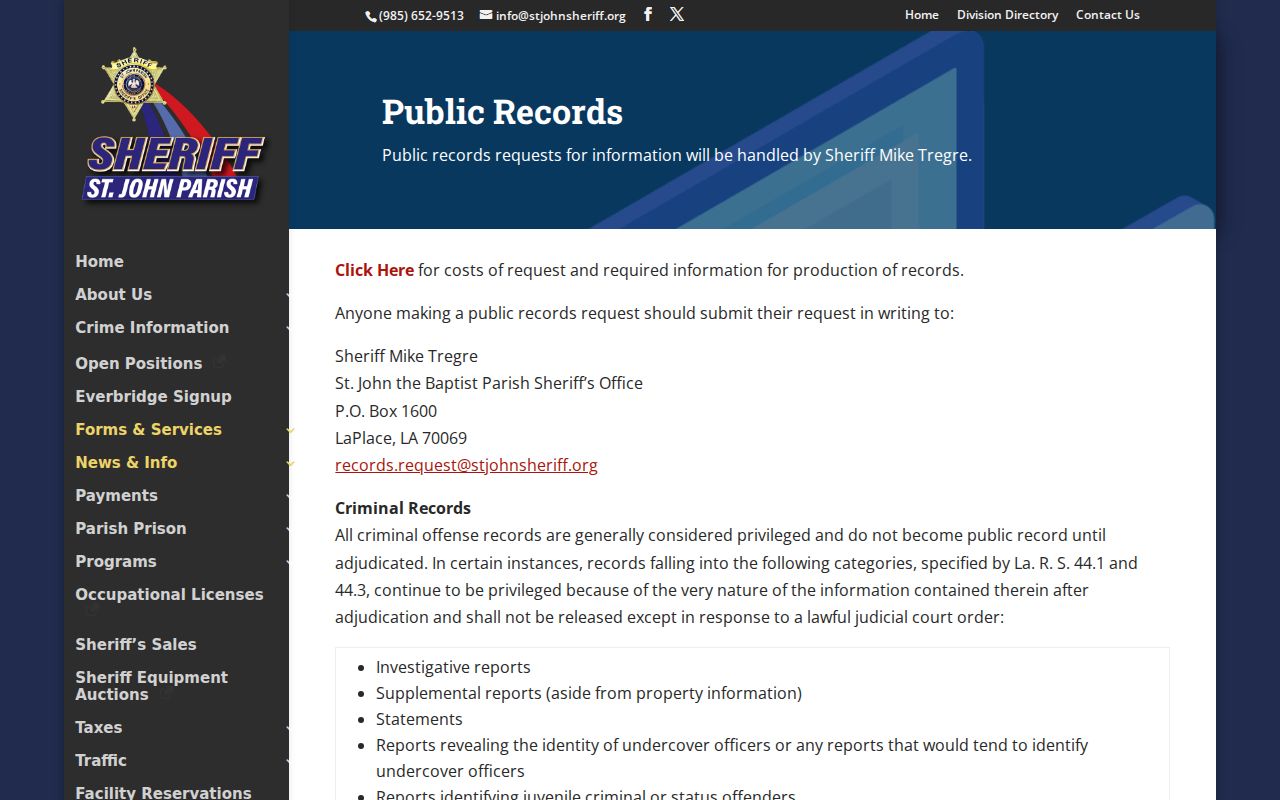
Ask for reasonably segregable public portions if part of a file is exempt. Active investigations, intelligence, juvenile data, protected victim information, sealed records, and security-sensitive material can be withheld or redacted under Louisiana law.
VINE and St. John Custody Status
VINELink supports current custody searching and notification registration. The name route commonly uses a last name with an optional first name; an offender or agency identifier may serve as an alternate key. A notification is a status service, not a certified booking record.
The official Louisiana VINE page supplies the live custody channel. The captured screen shows the statewide system used alongside the parish jail.

Older roster presentations offered A through Z filters, a Show All choice, an offender count, and a Central Time update stamp. Current controls may change. Call 985-359-8625 when the interface does not answer whether a person remains in St. John custody.
Warrant Labels in St. John Arrests
A judicial warrant follows a judge’s probable-cause decision. Bench and attachment warrants commonly concern a court requirement such as appearance or contempt. A fugitive warrant points to another jurisdiction’s demand, so the underlying case may belong outside St. John the Baptist Parish.
No dependable unrestricted parish active-warrant database was verified. Use the fallback chain: call the Sheriff, contact the Clerk with a docket number, inspect executed-warrant entries in the archive, make a focused public-record request, and contact the named outside agency for a fugitive hold. Sealed, juvenile, and unexecuted investigative warrants may not be public.
Arrests Are Not Convictions
An arrest is an agency action based on alleged facts and legal authority. A conviction is a court result after a guilty plea or verdict. The two records come from different custodians and can contain different charge wording.
| Question | Arrest record | Conviction record |
|---|---|---|
| Who creates it? | Arresting agency and jail | 40th JDC and Clerk |
| What charge appears? | Initial charge at arrest or intake | Charge filed and resolved in court |
| What does it prove? | An arrest was recorded | A court entered a guilty outcome |
| Best final source | Agency report | Certified Clerk disposition |
Note: An arrest is not proof of guilt, and every final outcome should be checked in the official court record.
St. John Arrests and Right to Review
A person reviewing their own statewide fingerprint-linked history should use the LSP Right to Review through LAPS. Louisiana does not provide an unrestricted public statewide name search. The state repository receives fingerprint-supported arrest cycles and reported dispositions, but updates may lag or require correction evidence.
The Louisiana statute on public access supplies legal context for dissemination. Its captured official page is a primary source rather than an aggregator.
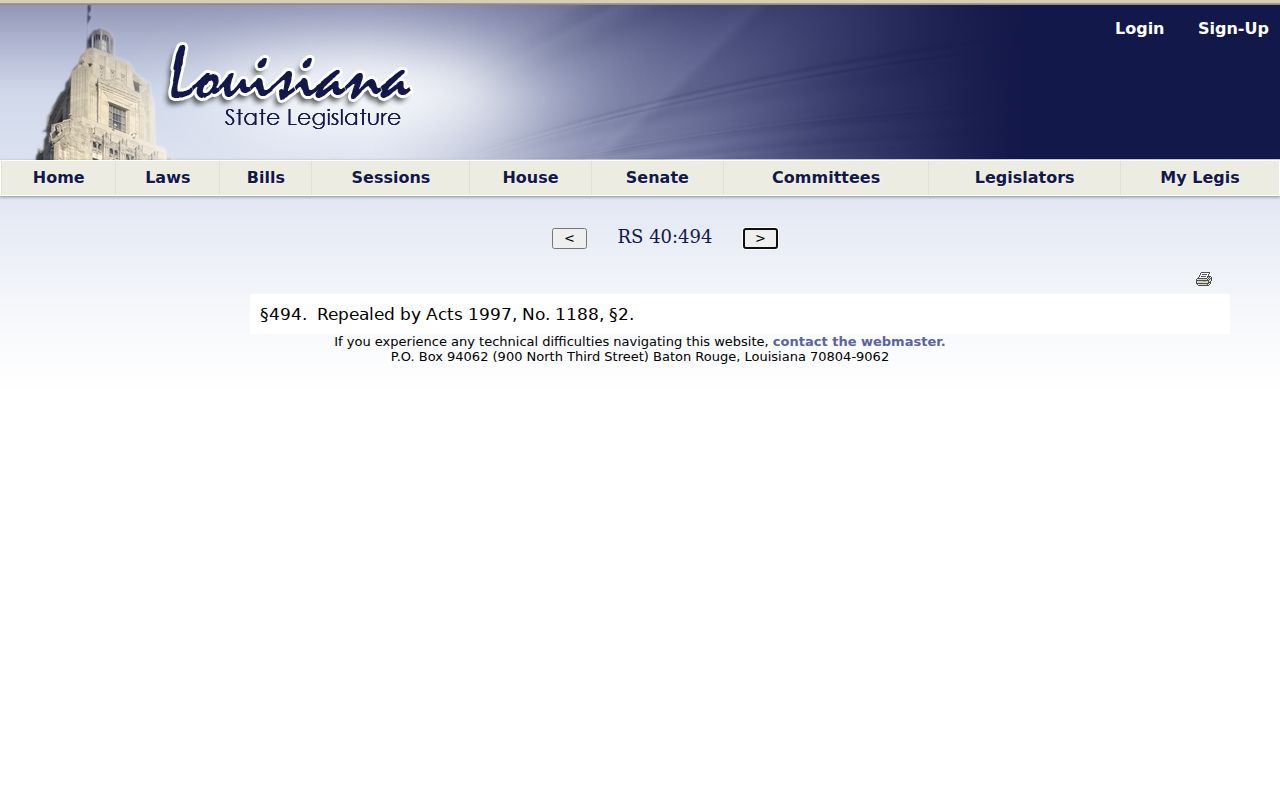
If the record is wrong, obtain the Right to Review, identify the arrest cycle, and secure a certified court disposition for the disputed outcome. Follow BCII correction directions rather than relying on a screenshot.
The agency name matters in every parish arrest lookup. Sheriff deputies handle primary patrol and investigations, but Louisiana State Police Troop B may create a highway or special-investigation report. Wildlife and Fisheries Enforcement holds its own boating or wildlife records. Probation and Parole can create violation or hold material, while a federal agency’s report and Eastern District docket stay outside the Sheriff’s complete file. Ask which agency created the record before paying for the wrong request.
The parish’s lack of incorporated municipalities removes a common source of confusion. LaPlace, Reserve, and Garyville have no separate police departments, municipal court clerks, or city jails. A local event normally routes to the St. John Sheriff, the correctional center in LaPlace, and the Clerk in Edgard. A locality printed in a dated report remains one data field. It may describe an address rather than the precise scene.
Public-record timing also needs Louisiana-specific care. When a record is not in active use, R.S. 44:33 generally contemplates prompt access. If it is in use, the custodian must certify that fact and set a time within three days, excluding weekends and legal holidays, for access. That does not promise release of active investigative details. Ask for the public, reasonably segregable part when narrative, evidence, juvenile, victim, or security material is withheld.
A release from the correctional center should not be read as a case outcome. The person may have posted bond, received recognizance release, completed a local sentence, transferred, or left by court order. Check Clerk Connect after filing time and use the docket number for the final disposition. If transfer to state custody is plausible, use the Louisiana DPS&C locator. Federal custody belongs in the BOP locator.
For a same-name problem, fingerprints provide the strongest identity link for one’s own record. Order the LSP Right to Review through LAPS, then compare each arrest cycle with certified court outcomes. Names can vary, charges can change, and updates can lag. A disciplined St. John the Baptist Parish review records the source and date of every finding so an old post, current VINE result, Clerk disposition, and BCII history are not collapsed into one claim.